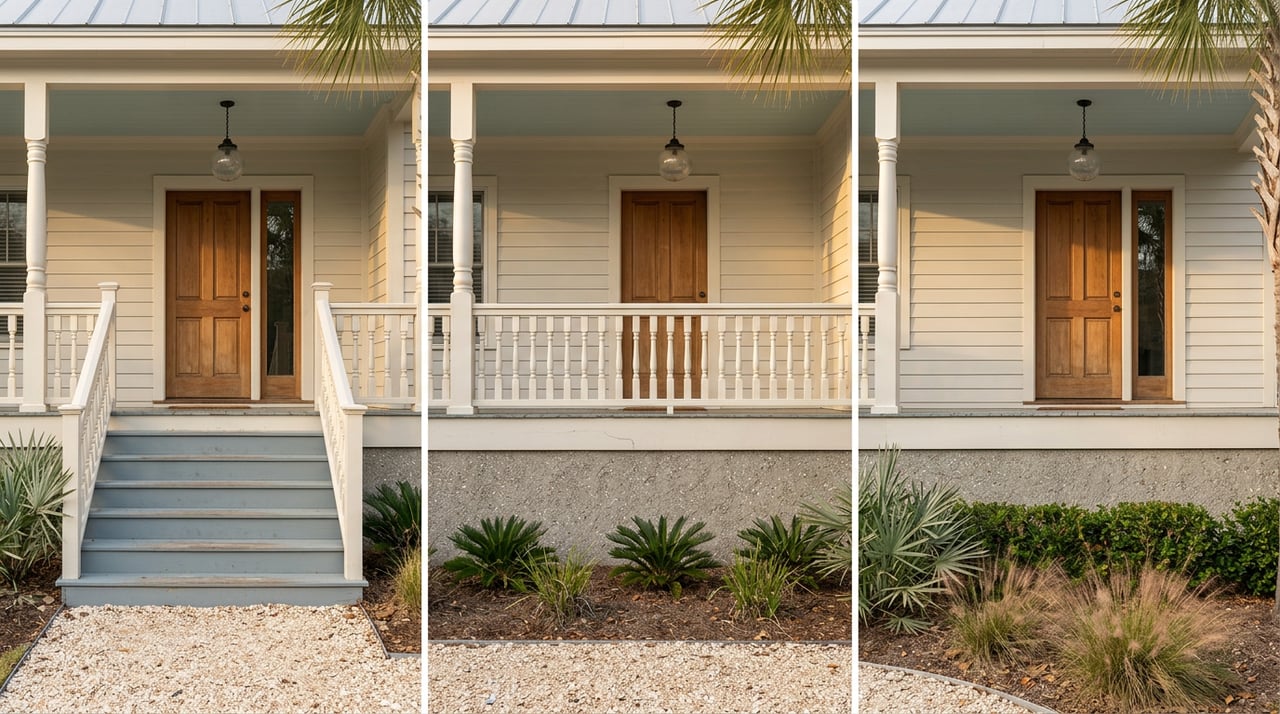
St. Augustine's "Historic District" Label Hides Five Different Real Estate Deals
August 20, 2026
August 20, 2026
Two houses on Marine Street went in front of the same city board within months of each other in 2020. One, at 67 Marine Street, needed a full elevation: a new first floor finished in stucco, new doors and a garage door, a new window and balcony, a new driveway, and the removal of some non-historic property walls, all on a building constructed around 1840. The other, next door at 66 Marine Street, needed the board to approve a metal fence and gate, or possibly the relocation of an existing wood fence and gate along the front of the building. Same board, same street, same "historic" label on both listings. One project took the better part of a year to work through. The other was a single meeting's worth of paperwork.
That gap is the thing most buyers miss when they see "historic district" on a St. Augustine listing and treat it as a single category with a single set of rules. It isn't. The city works from two overlapping maps at once, the pricing swings by tens of thousands of dollars a block apart, and the flood exposure that drives your insurance quote depends on which side of a few specific streets your address sits on. The label tells you almost nothing about which version of the transaction you're actually buying into.
Here's the part that rarely makes it into a generic buyer's guide: St. Augustine runs its historic preservation rules through two different systems that don't always draw the same lines. The Historic Architectural Review Board, known locally as HARB, oversees five Historic Preservation zoning districts, labeled HP-1 through HP-5, and a Certificate of Appropriateness is required for most exterior work inside them. Separately, the city has seven National Register Historic Districts recognized at the federal level, including Lincolnville North City, the Abbott Tract Subdivision, the Model Land Company Subdivision, and Fullerwood Park District, with several more (Lighthouse Park, Kingsland Addition, Nelmar Terrace among them) nominated for the same status. A property can be a contributing structure to a National Register district and sit outside an HP zoning district, or the reverse. The city's own preservation office estimates that the buildings carrying this kind of designation make up roughly a quarter of St. Augustine's total building stock, packed into about 7 percent of its land area, according to the city's Historic Preservation Updates page.
Practically, that means the neighborhoods people casually lump together as "historic St. Augustine" are not interchangeable:
| District | What actually separates it |
|---|---|
| Historic Downtown / Old Town | The oldest structures and the tightest design scrutiny, concentrated near St. George Street; mixes bayfront blocks with some higher ground |
| Lincolnville | Low-lying near Lake Maria Sanchez, takes on water during king tides and heavy rain events, growing renovation activity on smaller cottages |
| Abbott Tract | Similarly low-lying, a contributing National Register district, historically among the areas that flooded during major storms |
| Davis Shores | Across the Bridge of Lions on Anastasia Island, saw some of the area's worst storm flooding during Hurricanes Matthew and Irma, waterfront pricing premium |
| North City / Fullerwood Park | Carry the same National Register status as Lincolnville and Abbott Tract but rarely show up in generic neighborhood guides |
That price dispersion shows up in the numbers too. As of mid-April 2026, there were 38 properties listed specifically under the Historic District designation, averaging $854,547 with a spread running from $229,000 up to $1,999,000. Zoom out to the whole city and the picture as of early August 2026 shows a median list price of $604,450 across 238 active listings, with a median sold price of $539,500 across 162 recent closings. A house wearing the historic label can trade well above or well below that citywide median depending entirely on which of the five districts, seven federal designations, and flood zones it happens to sit inside.
HARB meets the third Thursday of most months at 1 p.m. in the Alcazar Room at City Hall, and the scope of what lands on its agenda ranges from the trivial to the structural. On a single 2022 agenda, A to Z Custom Homes appeared for jobs as routine as swapping asbestos roof shingles for composite slate ones, while the Carrion Revocable Trust needed a separate Certificate of Partial Demolition just to remove a brick chimney from a building constructed around 1910 to 1917 in the North City district. Even paint colors get real scrutiny: in August 2025, the board spent part of a meeting debating whether a proposed storefront color scheme on St. George Street read as Mediterranean or Colonial Revival, weighing that against the building's documented mid-century alterations before deciding whether to approve it outright or send it back for changes.
There's a rule buried in the demolition code that catches people who assume the review only applies inside the five HP zoning districts: any structure 50 years or older within city limits requires a Certificate of Demolition for full demolition, regardless of whether it sits in a designated district at all. A 1976-built ranch house outside any of the named historic neighborhoods can still trigger that review the moment it turns 50, which it likely already has if it was built before 1976.
There's an upside worth knowing about too. The city's Ad Valorem Tax Exemption program rewards owners who take on qualifying rehabilitation work. To qualify, the project generally needs to clear a cost floor of $20,000 or half the structure's assessed value before the work started, whichever is lower, with at least a quarter of that spending going toward the exterior or foundation, and the finished work has to meet the Secretary of the Interior's Standards for Rehabilitation as confirmed by HARB. It's a real financial lever for anyone planning a substantial renovation, and it only applies to properties that carry the qualifying historic status in the first place, another reason it matters to know exactly which designation your specific address holds before you write an offer.
The line between "approved next meeting" and "approved next year" in St. Augustine's historic districts usually isn't about the size of the project. It's about which of two overlapping designations your specific address happens to carry.
If you're eyeing a historic-zoned lot with plans for an accessory dwelling unit, budget accordingly: standard residential permitting typically runs 4 to 7 weeks, while historic district parcels add another 4 to 12 weeks on top of that for HARB review, even though Florida's 2025 statewide ADU law generally gives single-family owners the right to build one.
Flood exposure in these neighborhoods isn't evenly distributed, and 2026 happens to be the year the cost side of that exposure shifted for the first time in a decade. Citizens Property Insurance Corporation, Florida's insurer of last resort, cut its homeowners multiperil rates by an average of 8.8 percent statewide effective July 1, 2026, its first rate decrease since 2015, according to the company's own rate announcement. Private carriers have started moving the same direction: Security First filed to reduce average dwelling and fire rates by 5.6 percent in 2026, part of a broader pattern of decreases tied to Florida's litigation reforms, according to industry rate tracking.
That's the tailwind. The headwind is still geography. St. Johns County carries a Community Rating System Class 5 designation from FEMA, putting it in the top 17 percent of CRS-participating communities nationwide and delivering a 25 percent discount on NFIP flood premiums that's been active since April 2023, a detail confirmed on the county's own floodplain page. County-wide, there are roughly 37,877 active NFIP policies averaging $788 a year, though that average obscures a wide range, and the county has recorded 7,637 flood claims totaling $250.2 million since 1978, averaging about $33,000 per claim. For 2026 buyers anywhere in St. Johns County, the practical planning range for total homeowners insurance runs roughly $2,000 to $6,500 or more a year depending on flood zone, roof age, and wind mitigation features, which means the exact same "historic" label can carry a very different annual insurance bill depending on whether the address sits on high ground in Historic Downtown or on a Lincolnville block that takes water on a king tide.
Does every older home in St. Augustine require HARB approval before renovation? Not necessarily for interior work, but any exterior change to a property inside one of the five HP zoning districts generally needs a Certificate of Appropriateness, and full demolition of any structure 50 years or older triggers review citywide, regardless of district.
Is flood insurance mandatory for historic district homes? It depends on the FEMA flood zone assigned to the specific address and whether the loan is federally backed, not on the historic designation itself. Two homes carrying the same historic status can sit in entirely different flood zones.
Does the 2026 insurance rate cut apply automatically to my policy? The Citizens reduction applies to new policies starting July 1, 2026, and to existing policies at renewal, so the timing of your purchase and your renewal date both matter to when you'd actually see it reflected.
If you're weighing a specific address against these overlapping rules, that's exactly the kind of property-by-property work we do before a client writes an offer. Market Makers Group can walk through the district designation, the flood picture, and the insurance math for the exact home you're considering. Get a free home valuation to start the conversation.
Stay up to date on the latest real estate trends.
Whether you’re buying your first home or planning your next sale, our team is here to guide you every step of the way.
ADDRESS 8380 BAYMEADOWS RD STE 17 JACKSONVILLE FL 32256