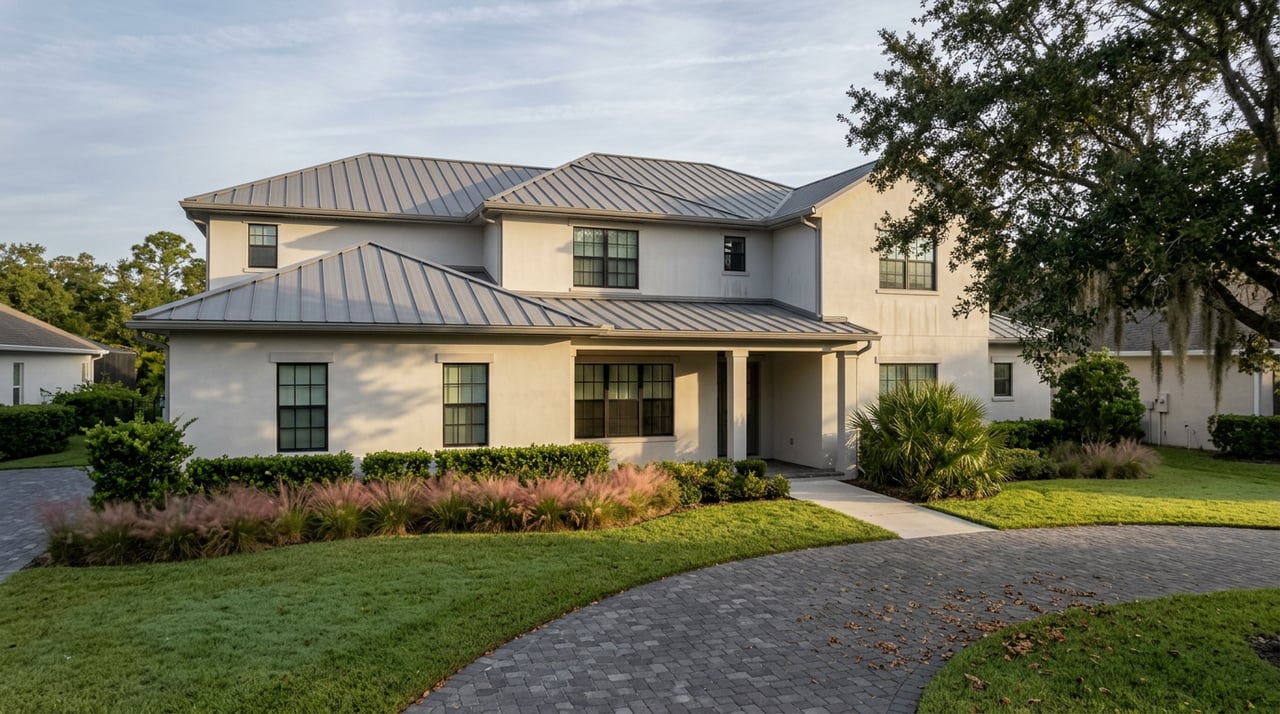
Why Two Jacksonville Homes at the Same Price Can Cost $150 a Month Apart to Insure
September 24, 2026
September 24, 2026
You've found the house. A 1920s bungalow in Avondale with original heart pine floors, or maybe a Craftsman in Riverside two blocks from the park. The price fits your budget, the inspection came back with the usual list of small fixes, and you're three weeks from closing. Then your insurance agent calls with a question you weren't expecting: what kind of electrical panel does the house have, and is any of the wiring original?
That call is the moment a lot of Jacksonville buyers first learn about the four-point inspection, a separate report that has nothing to do with whether the house is livable and everything to do with whether an insurer will write a policy on it. It's not optional paperwork. Without it, many carriers won't issue coverage on an older home at all, and without insurance, a mortgage lender won't close the loan.
A four-point inspection looks at exactly four systems: roof, electrical, plumbing, and HVAC. It skips the foundation, the windows, the crawlspace, everything a standard home inspection covers. Its only job is to tell an insurance underwriter whether this specific house is a risk they're willing to take on.
Citizens Property Insurance Corporation, Florida's state-backed insurer, requires one on any dwelling application for a property more than 20 years old, and its inspection checklist spells out the failure points in detail: exposed wiring or active leaks that need repair before coverage can be issued, and roofs older than 25 years for shingle or 50 years for tile, slate, or metal that need documentation showing at least five years of remaining life. Private carriers set their own age thresholds, and in 2026 several have loosened those thresholds somewhat, with some pushing the 4-point trigger back toward 25 or 30 years instead of 20. But the pattern holds across nearly every carrier: age, not price, decides when this inspection gets ordered.
That distinction matters because it means two homes can sit at the same price point and land in completely different underwriting categories, based entirely on the year they were built.
Jacksonville's historic core, Riverside, Avondale, Springfield, San Marco, Murray Hill, and Ortega, is full of houses built in the early 20th century, and that housing stock carries specific, well-documented red flags for insurers.
Knob-and-tube wiring, the ceramic-knob-and-porcelain-tube system that was standard from roughly the 1880s through the 1940s, still turns up behind plaster walls in these neighborhoods. Virtually no standard Florida carrier will write a policy on a home with active knob-and-tube in 2026, and a partial rewire doesn't solve the problem. Insurers want documentation that every inch of the original wiring has been removed or professionally decommissioned, not just the visible portions.
Aluminum wiring is the second common trip point, and it's tied to a narrower build window: homes constructed between 1965 and 1973 across Northeast Florida. It isn't an automatic decline, but carriers look for specific remediation, connectors like AlumiConn or a Copalum crimp, before they'll insure it.
Then there's the panel itself. Federal Pacific and Zinsco panels, both discontinued decades ago after documented histories of breakers that failed to trip during overloads, are named specifically on inspection checklists as red flags that can get a policy denied or canceled outright.
Plumbing carries its own version of this problem. Polybutylene piping and galvanized steel supply lines, both common in homes built before the 1990s, get flagged for their failure risk even when there's no active leak at the time of inspection. Underwriters aren't just checking whether a system works today. They're pricing the likelihood it fails in the next five years.
None of this means a 1920s Avondale bungalow is uninsurable. It means the systems inside it, not its curb appeal or its price tag, are what an underwriter is actually pricing.
Here's where the math gets concrete. One Northeast Florida insurance agency that reviewed more than 2,000 active homeowners policies found two houses in the same 32259 ZIP code, both carrying roughly $450,000 in dwelling coverage. One, built in 2019 with a hip roof and impact-rated garage door, insures for under $2,100 a year. The other, built in 1994 with a 2012 shingle roof, insures for over $3,900. Same ZIP code, similar coverage, a gap of roughly $150 a month for the same protection.
Zoom out to a neighborhood comparison and the pattern holds. San Marco, ZIP 32207, carries a median home value around $277,000 and average annual insurance near $3,018, an insurance-to-value ratio of about 1.1 percent. Newer construction in areas like Nocatee runs closer to 0.5 percent, roughly half. That agency also documented a client who moved from a 1985 home in 32225 into a 2021 build in Nocatee. Their home value went up by nearly $200,000. Their annual insurance premium dropped by more than $1,400. A more expensive house, cheaper to insure, because the systems underneath it were newer.
For a typical Northeast Florida home in the 1,800 to 2,500 square foot range with $350,000 to $500,000 in dwelling coverage, most owners are paying somewhere between $2,800 and $4,000 a year in 2026. Where a specific property lands in that range has less to do with its neighborhood's reputation than with the age of its roof, panel, and pipes.
This isn't a case against buying older. Riverside, Avondale, and San Marco carry a housing character you genuinely cannot get in new construction, and plenty of these homes carry updated systems that insure without incident. The point is that the insurance line item deserves the same weight in your comparison as square footage or commute time, because it behaves like a second, permanent payment.
It also affects your buying power directly. A gap of roughly $155 a month between an older home's premium and a newer one's, folded into a mortgage payment at a 7 percent 30-year rate, is the equivalent of about $23,000 in loan qualifying capacity. Two buyers with identical incomes can qualify for meaningfully different purchase prices depending on which neighborhood, and which era of construction, they're comparing.
If you're looking at anything built before roughly 2006 in Jacksonville's older neighborhoods, a few steps change the outcome:
Order the four-point and wind mitigation inspections at the same time as your standard home inspection, not after you're under contract. Bundling saves money and gives you leverage while there's still room to negotiate.
Ask directly about panel brand and plumbing material before you tour a second time. A seller or listing agent who already knows the electrical panel is a Federal Pacific, or that the supply lines are original galvanized steel, can save you a wasted inspection fee.
If the report comes back with knob-and-tube, an aluminum wiring flag, or a recalled panel, get a repair quote before you finalize your offer. These are negotiable line items, not deal breakers, but only if you know the number before you're two weeks from closing.
Keep every permit and invoice for electrical or plumbing work done on an older home. Documented, permitted upgrades are what let an agent shop your policy across more carriers and get you a rate that reflects the work you've actually done, not just the year on the deed.
Does a four-point inspection replace a full home inspection? No. A four-point only covers roof, electrical, plumbing, and HVAC, and it exists to satisfy an insurer, not to give you a full picture of the property. Order both.
Does every older Jacksonville home fail its four-point? No. Plenty of homes in Riverside, Avondale, and San Marco have been rewired, repiped, or re-roofed over the years and pass without issue. The report simply tells you, and your insurer, which category a specific house falls into.
Can a low four-point score kill a deal? It can delay one. If a buyer can't secure a policy, a lender typically won't fund the loan, which is why ordering this inspection early, rather than the week of closing, matters more than almost any other step in an older-home purchase.
If you're weighing a historic bungalow in Avondale against a newer build in Nocatee or Fleming Island, the insurance math is often the piece that decides which one actually fits your budget. The team at Market Makers Group can walk that comparison with you, neighborhood by neighborhood, and help you put a real number on what your current home would need to sell for to make the move work. Start with a free home valuation.
Stay up to date on the latest real estate trends.

Whether you’re buying your first home or planning your next sale, our team is here to guide you every step of the way.
ADDRESS 8380 BAYMEADOWS RD STE 17 JACKSONVILLE FL 32256